What to Expect on a Naples Underground Tour
If you have never been below Naples, it helps to know what a tour actually involves — not the marketing version, but the real sequence of steps, tunnels, temperature and timing. Here is what to expect, start to finish, and you can line it up against the options on our Naples Underground tours page as you read.
Before you descend
Tours gather at a meeting point above ground — often a central square such as San Gaetano, Bellini, Dante or Municipio, depending on the operator. Arrive a little early, especially in high season, and confirm the language of your departure: English slots are more limited than Italian ones. Our visiting hours and tickets page lists the practical details.
The descent
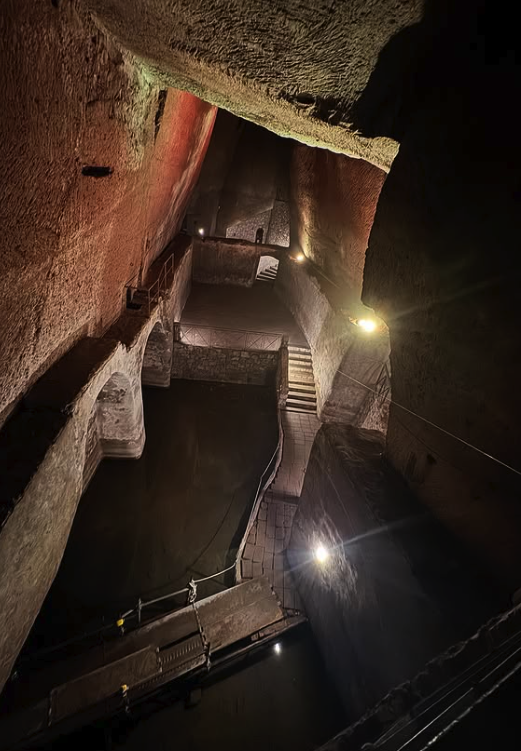
Most routes begin with a long staircase — around 121 steps on the main aqueduct tour — and the temperature drops noticeably as you go. By the bottom you are roughly 40 metres beneath the streets, in air that stays cool and steady all year. The walls are the honey-coloured tuff the whole system is carved from, and the light is deliberately low and atmospheric.
Did you know? You end up about 40 metres down after roughly 121 steps — deep enough that the temperature is noticeably cooler than the street, which is exactly why the cisterns worked as wartime shelters.
The cisterns and the Roman render
The largest chambers were water cisterns, some in use since antiquity. Standing at the bottom of one, it is easy to picture it full: smooth walls shaped to hold water, openings overhead through which the well-keepers once drew it. Guides often point out the original Roman render still coating the stone. If the engineering fascinates you, our page on the underground path follows the route chamber by chamber.
The narrow passage
The part people remember is a tight, low passage crossed almost sideways, frequently lit only by a candle or phone torch. It is short, and it is optional: every operator lets you skip it and rejoin on the far side. Going through is the closest you come to how the water-carriers once moved through the rock. If you are travelling with children, our guide to visiting with kids covers how to handle it.
Useful tip. Wear closed shoes with grip and bring a light layer even in a heatwave — the floors are uneven and sometimes damp, and the steady cool surprises visitors who arrive dressed for the sun. A phone torch doubles as a safety aid and a way to light photos.
The wartime layer
In several sections the tunnels are furnished with the traces of their Second World War use: scratched inscriptions, rusted bed frames, toys and household objects left where families sheltered. Guides tend to slow down here, and rightly — it reframes the whole visit as memory as much as archaeology. The full back-story is in our history of the Naples Underground.
The Roman theatre
On the Napoli Sotterranea route the tour surfaces into a real surprise: a Roman theatre buried beneath the modern city and entered through what is now an ordinary building. You step from a family’s home into ancient stage machinery, with apartments built directly over the old seating.
Did you know? The buried theatre is associated with the emperor Nero, who is said to have performed in Naples — and today you reach it by walking through someone’s apartment, a perfect image of a city that never stopped building on itself.
How long, and how hard
An underground-only tour runs about an hour to an hour and a half; combined city-and-underground walks run longer. The difficulty is almost entirely the stairs and the confined spaces: a moderate level of fitness makes it comfortable, and the narrow passage can be skipped. It is not wheelchair accessible — see our accessibility guide — and not ideal for severe claustrophobia, but for most visitors it is well within reach. Note, too, that this is the aqueduct network, not the Catacombs of San Gennaro, which are a separate site.
Common worries, answered
Visitors ask most about three things: claustrophobia, fitness and hearing. On claustrophobia, the only genuinely tight spot is the narrow passage, and every operator lets you skip it, so the tour is manageable for most people who are merely uneasy. On fitness, the challenge is the stairs, not speed — there is no rush, and a moderate level of fitness is enough. On hearing, groups can be large and stone tunnels echo, so if catching every word matters, take any headset offered and stay near the guide, or choose a smaller-group tour like the Spanish Quarters tour.
Photography below ground
Photography is generally welcome, and the underground is wonderfully photogenic — lamplit tuff, still cistern water, the glow of a candle in the narrow passage. The low light is the challenge: a phone torch doubles as both a safety aid and a way to light a shot, and steadying your phone against a wall helps in the dark. Be considerate of the group, keep moving through the tight sections, and resist a harsh flash that flattens the very atmosphere you came to see.
A short packing checklist
You need very little, but the right little makes a difference: closed shoes with grip for the uneven, sometimes damp floors; a light layer for the steady cool; a phone with a working torch; and some water for the climb back up. Leave large bags and pushchairs behind — the less you carry through a narrow passage, the easier it is. If you are travelling as a family, our guide to visiting with kids has more, and the quick answers live on our FAQs page.
Timing your visit
Mornings are calmest and English slots are limited, so book ahead for the language and time you want. In the height of summer the cool underground is a genuine relief from the heat above, which also makes midday the busiest window — a trade-off worth planning around. Avoid scheduling the underground at the very end of a long, hot sightseeing day; the staircase deserves fresh legs, and you will take far more in when you are not already tired. Our visiting guide has the current hours.
How it fits a Naples itinerary
Part of the pleasure is the contrast on the way back up: from cool, hushed stone to the bright, loud, crowded streets of Naples in minutes. The tour pairs naturally with a wander through the surrounding historic centre, a coffee standing at a bar, and — if you have the appetite — a pizza, since Naples is where it was invented. Few sights leave as strong an impression for as little effort: an hour underground costs you a staircase and a modest ticket and hands back a completely fresh perspective on the city.
Coming back up
The tour ends with the climb back to street level and the cheerful shock of returning to the noise and heat of Naples. Most people surface having understood the city differently. If you are still deciding which site to enter, our guide to which entrance is which will help — then you can book the skip-the-line ticket or compare all the tours.