A Short History of Naples Underground
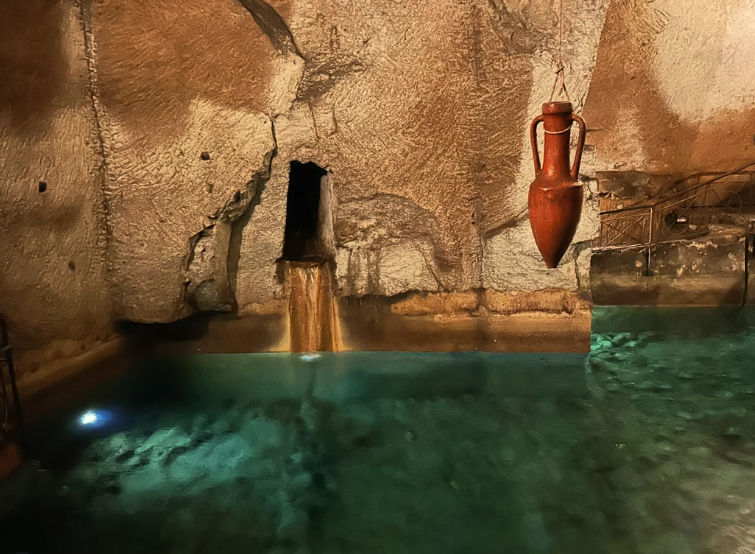
The Naples Underground is not one thing built at one time. It is the accumulated hollow beneath a city that has been quarried, plumbed, abandoned and sheltered in for more than two thousand years. Told from below, the story of the tunnels is the story of Naples itself — and every one of our Naples Underground tours is really a walk through that timeline.
A timeline in stone
If you want the whole arc at a glance, it runs roughly like this:
- Greek era — settlers quarry building tuff, opening the first great chambers.
- Roman era — the cavities are engineered into an aqueduct and cisterns.
- 1880s — a cholera epidemic ends the old water system; the network is sealed.
- 1940s — families shelter below during the wartime bombing.
- Late 20th century — the tunnels are cleared, mapped and reopened.
Greek beginnings
When Greek settlers founded Neapolis they found their building stone directly beneath their feet: a soft, pale volcanic tuff that could be cut by hand and hardened once exposed to air. Quarrying it left large voids — the first chambers of the underground. The same stone raised the city above while hollowing the caverns below, so Naples and its shadow grew together from the start. You can see how the route threads those chambers on our page about the underground path.
The Roman aqueduct
The Romans turned those quarry voids into infrastructure, cutting channels through the tuff and lining them with a waterproof render so they would hold. It was a substantial system, threading kilometres of hand-cut conduit beneath the streets, and it supplied Naples for centuries.
Did you know? Some of the original Roman waterproof render still coats the cistern walls and continues to do its job after two thousand years — ask your guide to point it out; it is one of the quietly astonishing details of the visit.
The well-keepers and the Munaciello
A system like this needs maintenance, and for centuries a guild of well-keepers — the pozzari — kept it working, lowering themselves down narrow shafts to clear blockages. Spending so much of their lives underground, and occasionally appearing unannounced in a cellar, they gathered a reputation that folklore turned into the Munaciello, the little monk who might leave a coin or play a trick. It is a reminder that this was a lived-in second city, not just plumbing.
Plague and abandonment
The underground supplied the city’s water into the modern era, but after the cholera epidemic of the 1880s the old well-and-cistern system was blamed for spreading disease. A new pressurised aqueduct replaced it, the shafts were sealed, and the network slipped out of everyday use for decades.
Shelter under fire
The Second World War gave the tunnels a dramatic second life. As bombing raids struck Naples, citizens descended into the old cisterns by the thousand, turning the cool, deep galleries into air-raid shelters. The traces they left — graffiti, bed frames, toys, everyday objects — are still part of what visitors see, and for many it is the most moving layer of the site. It is also the part that lands hardest with children, as we note in our guide to visiting the Naples Underground with kids.
Did you know? The buried Roman theatre on the Napoli Sotterranea route is associated with the emperor Nero, and you reach it through an ordinary apartment building — homes were built directly over the old seating.
Rediscovery
In the later twentieth century the underground was cleared, mapped and gradually opened. Walk it today and you are reading the sequence in the stone, from the tool-marks of the quarrymen to the scratched names of families waiting out an air raid. For more dates and numbers, our facts and figures page lays them out; for the broader story of the site, see our history of the Naples Underground.
Useful tip. Choose a guided tour rather than a rushed walk-through if the history is what draws you — the best guides are local enthusiasts who will happily explain how a Greek quarry became a Roman reservoir became a wartime shelter.
The stone that made it possible
None of this history would exist without the rock. Naples sits on a thick bed of volcanic tuff, soft enough to cut with hand tools yet firm enough to hold a vault once shaped. That combination is why the Greeks quarried so freely and the Romans tunnelled so far, and why the walls have the warm, honey-grey colour visitors notice at once. The same porous stone also cools and filters the air, which is why the galleries stay comfortable year-round and made such effective shelters. Our underground path page traces how the route moves through that stone.
How much is open today
The full network runs to many kilometres of hand-cut passage, only a small fraction of which is open to visitors. Much of what you can walk today was cleared and mapped only in recent decades, as volunteers and speleologists hauled out a century of dumped rubble and reconnected chambers sealed since the 1880s. The route you tour is a curated, safe path through a far larger warren — enough to make the history vivid without pretending to show all of it. Guides often gesture at a bricked-up opening and explain that the tunnels continue well beyond the lit section.
Reading the layers on a tour
A good guide treats the underground as a timeline you can touch. In one wall you might see the parallel tool-marks of Greek quarrymen; a few metres on, the smooth Roman render that made a rough cavity watertight; then, at eye level, the scratched names of families sheltering during the war. Learning to read those layers turns a walk through dark tunnels into a walk through time. If dates and numbers are your thing, our facts and figures page collects them, and our guide to which entrance is which explains where each layer is best seen.
Why the history still matters
The Naples Underground is not a ruin frozen at one moment; it is a space every age has reused for its own needs, from water supply to bomb shelter to visitor attraction. That continual reinvention is the real subject of the place, and it mirrors the city above, where new buildings have always risen on old ones. To descend is to see, compressed into a single hour, how Naples has spent two and a half thousand years building on top of itself. It is a story best appreciated on a guided visit, so it is worth comparing the tours before you go.
The people who worked below
It is easy to think of the underground as empty engineering, but for most of its life it was a workplace. The pozzari spent their days in the shafts; after them came the wartime families who turned the cisterns into bedrooms, and the tunnel-clearers of the twentieth century who hauled out the rubble by hand. Every layer you see was shaped by someone’s labour, and the graffiti and objects left behind give the place a human warmth that pure archaeology often lacks. It is this lived-in quality that most visitors remember, and it is worth choosing a guide who tells those human stories as well as the dates — a good reason to read a few traveller reviews before you book.
Two and a half thousand years, one space
What makes the history compelling is the reuse: the same cavities served as Greek quarry, Roman aqueduct, wartime refuge and, finally, rediscovered monument. To descend even a little way is to understand the living city from its foundations up. When you are ready to see it for yourself, you can compare the Naples Underground tours or read what to expect on the day.