Inside Naples Underground: What You See, in the Order You See It
Short answer: the official route runs about an hour and comes in six stages: 136 steps down, the quarry chambers, the aqueduct channels, the cisterns, an optional candlelit passage, then the wartime shelter and the Roman theatre before you climb back out. The decision point is the candle, about two thirds of the way through.
Before the stairs
You gather at street level, usually in a lane that does not look like the entrance to anything. There is a short briefing, and then the stair. Everything after that happens in the order below, and the timings are the ones a guide actually keeps to rather than the ones a listing quotes.
Stage one: 136 steps, five minutes
The descent is a single staircase rather than scattered flights. The risers are low because the stair was cut for people carrying loads, and there is a handrail the whole way. Somewhere around a third of the way down the air changes — cooler, still, and slightly mineral. That moment is the one people remember from the descent, not the count.
There is no lift. You climb the same stair at the end, on tired legs, which is the part worth planning for rather than the way down.
Stage two: the quarry chambers, ten to fifteen minutes
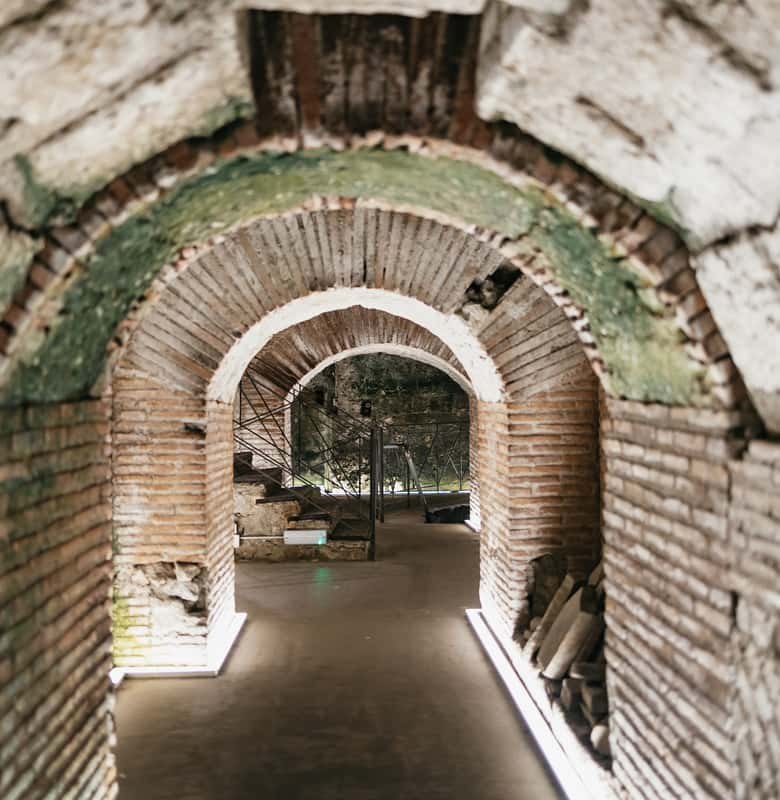
The first proper stop is a room, not a tunnel. Quarrymen cut the tuff out from here and hauled it up a shaft to build whatever was going up above; the chambers are wider at the floor than at the ceiling because the shaft had to stay narrow and the working face wanted room. Tool marks are legible on the walls, and they change from one face to the next.
Stage three: the aqueduct, fifteen to twenty minutes
This is the longest single section and the one you walk along rather than look at. The channels were cut between the quarry voids and plastered to carry water; much of the plaster is still there, and so are the levelling marks. Look up regularly — the vertical shafts overhead each dropped into a courtyard, which is how a household got water without leaving home.
The pozzari who kept these channels clear are the usual explanation for the munaciello, the small hooded household spirit of Neapolitan folklore. The history follows that thread from the Greek quarries to 1885.
Stage four: the cisterns, five to ten minutes
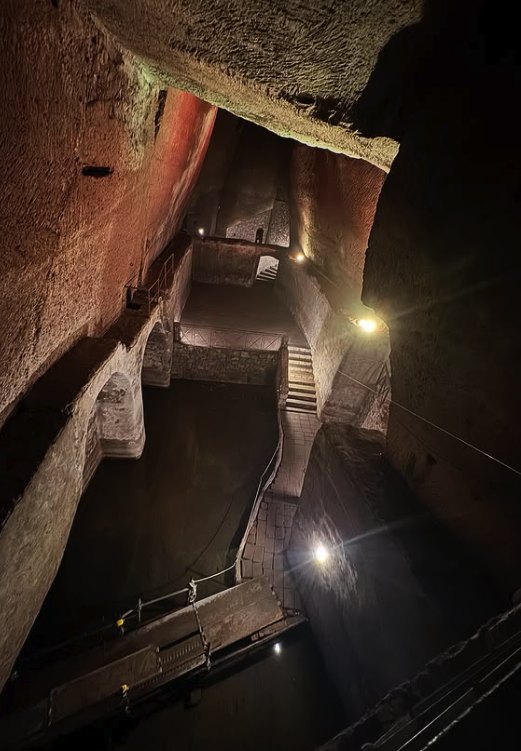
Sealed chambers, filled from the channels, drawn from above by bucket. Several still hold water: green, entirely still, and deeper than it looks from the walkway. The waterline on the wall above the current level is worth finding, because it is not where anybody guesses.
Stage five: the candle, and the decision
About two thirds of the way through, the route offers a short passage barely shoulder-wide leading to a Roman cistern, walked by candlelight. This is the only genuinely tight stretch on the route and it is entirely optional.
| If you go | If you stay |
|---|---|
| Roughly ten minutes, single file, candle in hand | Roughly ten minutes waiting at the wider end |
| The one moment where the candle is the only light | No pressure — the choice is built into the tour |
| Hard to photograph; the part people describe afterwards | You rejoin the same group and continue together |
What happens either way.
Nobody is separated for long, and nothing later on the route is tight. If you are unsure, go as far as the entrance and decide there — guides expect it.
Stage six: the shelter and the theatre, twenty to twenty-five minutes
The last section is the one that goes quiet. Bunk frames, tins and children’s toys were left where they were between 1940 and 1944, and so were the charcoal drawings on the tuff. One of them, a woman’s profile with an elaborate hairstyle, is among the best-known images in the whole system. Several of the drawings sit at child height.
The Roman theatre of Neapolis closes the visit, and it is reached from the street rather than through the tunnels — you walk into what is still somebody’s building to find it. Its upper seating tier, the Summa Cavea, has recently been brought back into the route.
Three things most people walk straight past
- The fill line. After the wells closed in the 1880s the tunnels were used as a dump. On several chamber walls you can still read the height the rubble reached.
- The marble bust in the niche. A bearded Roman head set into a recess cut in the tuff, at the edge of the lit area.
- The joins between periods. In two or three places a Greek cut runs into Roman plaster runs into a 1940s widening, inside one arm’s length of wall.
What each space was for, rather than what it feels like, is set out on the Napoli Sotterranea route page.
Photographs, and why yours will disappoint you
Photography is permitted and you are told so directly. The lighting is warm, low and directional, which flatters the stone and defeats phone sensors. Bracing against a wall works better than pushing the exposure, and the cisterns reward patience more than the passages do. The candlelit stretch is effectively unphotographable, which is part of why people talk about it.
What the other three undergrounds show you instead
The six stages above are the official route. The other three sites in this subject are shaped completely differently, which is worth knowing before you assume one visit covers them all.
| Route | The shape of the visit | The thing you remember |
|---|---|---|
| Napoli Sotterranea | Six stages, about an hour, guided | The candlelit passage |
| Spanish Quarters (LAES) | One continuous hour, guided | Wall writing left by people sheltering from the raids |
| Neapolis Sotterrata | A Roman street you walk at your own pace | Shopfronts and the covered market |
| The catacombs | Forty-five guided minutes in burial galleries | Skulls set into the walls of the ambulatory |
What each route puts in front of you.
Full profiles of all four are on the four undergrounds, and the fares side by side are on entry tickets.
How the hour feels, physically
Nobody warns you about this part, so here it is. The air is cool and dry rather than damp, and it stays the same temperature from the bottom of the stairs to the top of them again. Sound behaves oddly: a guide twenty metres ahead in an aqueduct channel is perfectly clear, and the same guide in a quarry chamber is not, which is why headsets exist on the larger groups.
The floor is even underfoot for most of the route but wet in patches near the cisterns. You will not need a torch, because the path is lit throughout, but the lighting is warm and low rather than bright, and your eyes take a minute at each new chamber. The climb out is the only genuinely tiring part, and it comes when you have already spent an hour on your feet.
Eat before, not after. An hour underground on an empty stomach followed by 136 steps is how a good visit becomes a bad memory. Via dei Tribunali directly overhead is one of the best streets in the city for exactly that — and hours and departure times will tell you which slot leaves you free for lunch.
What to ask your guide
Guides on this route field the same handful of questions all day, and enjoy anything past them. Three that reliably open something up:
- Where does the fill line stop? After the wells closed the tunnels were used as a dump, and the height the rubble reached is legible on several walls.
- Which marks are Greek and which are Roman? In two or three places both, plus a 1940s widening, sit inside one arm’s length of wall.
- Who drew that? The charcoal figures in the shelter have stories attached, and some of them sit at child height.
The background to all three is on the history.
Coming back up
You return to the same square you left, which is disorienting in a useful way. The street you step onto sits directly above the channels you have just walked. Give yourself a minute before you decide where to go next; most people want a coffee and twenty minutes of daylight.
If the stairs rule this route out, steps and access compares every underground here on exactly that, and getting to the entrances has the doors. Every tour that walks this route is listed on naples underground tour napoli sotterranea, and all of them on Naples Underground Tours.
Tours that fit this post
Walk it with a guide