13 Facts About Naples Underground That Will Surprise You
Short answer: Naples was quarried out of its own foundations, and the hole is still there. Thirteen things below are the ones that surprise people most, from a household spirit that started as a maintenance crew to a Roman theatre you reach through somebody’s building.
1. The city is built out of the hole underneath it
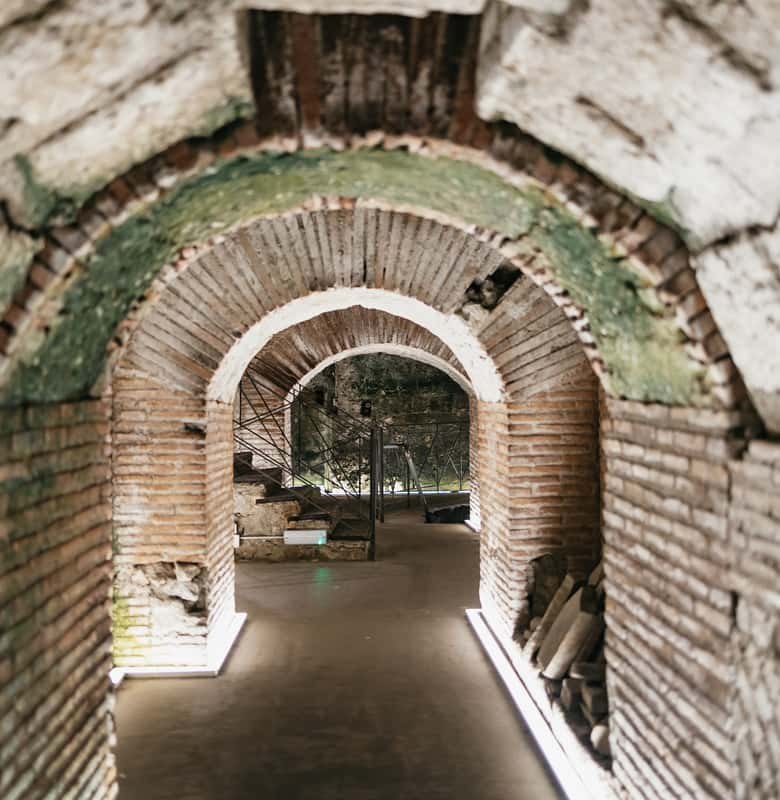
Yellow Neapolitan tuff cuts with hand tools and hardens in air. Rather than haul stone in, builders sank a shaft and quarried directly beneath the site they were building on. The palazzo above and the void below were made in one operation, which is why the walls forty metres down are the same colour as the facades on via dei Tribunali.
2. The chambers are bell-shaped, and that is engineering
Wider at the floor than at the ceiling, for the same reason a bell is: the shaft at the top had to stay narrow, and the working face at the bottom wanted room. It is a shape produced by the job rather than chosen for effect.
3. Naples’ household spirit began as a maintenance crew
The pozzari climbed the shafts to keep the channels and cisterns clear, coming and going through the courtyards of houses they did not live in, often taking the food left out for them. That is the usual explanation for the munaciello: a small hooded figure who appears unannounced and brings luck or mischief depending on how he is treated.
4. Cholera closed the system, not neglect
After the epidemic that struck Naples in the 1880s the well network was shut and the city moved to piped supply. The tunnels were sealed, and for two generations they served as a dump. On several chamber walls the height the rubble reached is still legible. The full chronology runs from 470 B.C. to the current clearance work.
5. The war reopened them, and the war is still on the walls
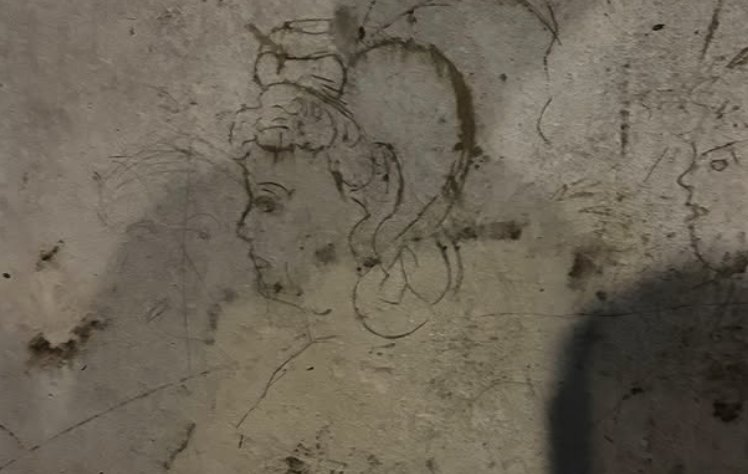
Naples was among the most heavily bombed Italian cities, and the tuff cavities were the safest space available. Bunk frames, tins and toys are where people left them. So are charcoal drawings, including a woman’s profile with an elaborate hairstyle that has become one of the best-known images down there. Several drawings sit at child height.
6. There is a Roman theatre under a residential building
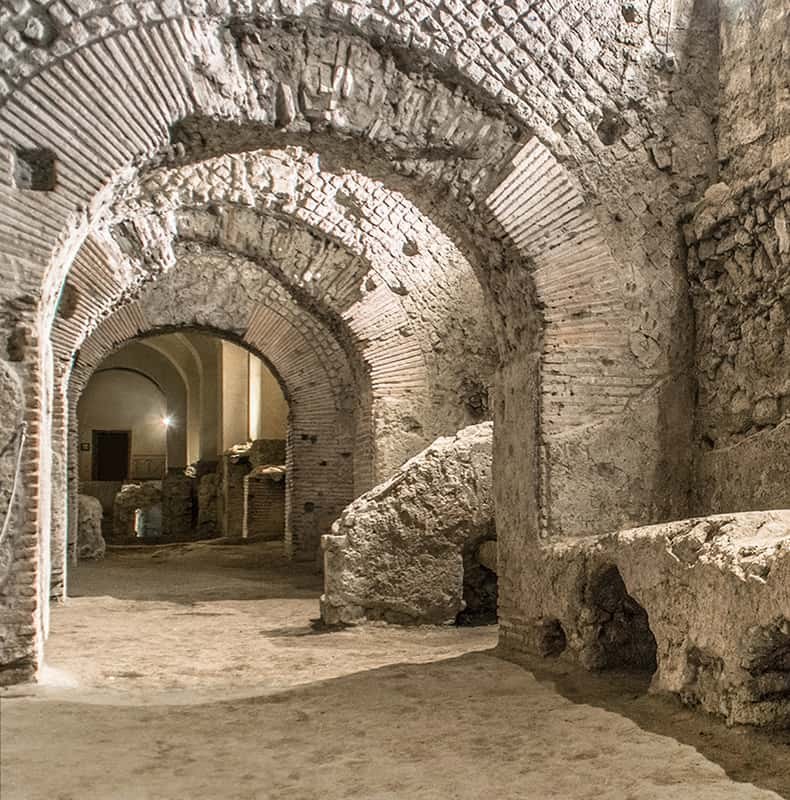
The theatre of Neapolis was not demolished so much as built over. Sections survive inside and beneath present-day houses, and you reach them from the street rather than through the tunnels. Its upper seating tier, the Summa Cavea, came back into the visitor route only recently.
7. Two different undergrounds share one square
Piazza San Gaetano 69 is Napoli Sotterranea, about forty metres down. Number 316 on the same piazza is San Lorenzo Maggiore, whose excavation sits about ten metres down and is a completely different site with a different ticket. People walk into the wrong one regularly. Getting to the entrances has photographs of both doors.
8. One of them is a Roman shopping street
Ten metres under number 316 lies a paved Roman street with its shopfronts, the treasury where the city’s money was kept, and the macellum — the covered market at the commercial heart of Greco-Roman Neapolis. It is the only route in this subject you may walk alone, with a free audio guide.
9. A painter took burial instead of payment
Giovanni Balducci decorated the Catacombs of San Gaudioso and refused a fee, asking instead to be buried among the city’s aristocrats. The same catacomb holds the tomb of Gaudiosus, a North African bishop buried there between 451 and 453, and seventeenth-century wall niches where skulls were set on display.
10. One ticket opens a second underground for a year
A San Gaudioso ticket admits you free to the Catacombs of San Gennaro for the following twelve months, guide included. It is the only genuine two-for-one in this subject, because each of the four sites is run by a different organisation.
11. There is a garden down there
A hydroponic growing experiment is kept under lamps at depth on the official route. It is a modern addition and presented as one, and it answers a question nobody thought to ask: what grows forty metres down if you give it light.
12. The step count is disputed by fifteen
Two booking listings quote 121 steps. The attraction’s own figure is 136. The difference does not change the climb, but it is a neat illustration of why the site’s own words beat a resale listing on anything factual.
13. A tour listing and the attraction can disagree about the same tunnel
The step count is one case. Another is depth: the official route publishes about forty metres, while the excavation under San Lorenzo Maggiore publishes about ten, and a listing that simply says ‘underground Naples’ may mean either. It is why every card here names the site it enters rather than the phrase the listing uses.
Where a resale listing and the site’s own website disagree on a fact about the tunnels — steps, depth, opening hours — the site’s own figure is the one used across these pages, and the difference is stated rather than smoothed over. The disclosure sets out where every number comes from.
14. Half the tours here never take you into the famous one
Of the routes bookable in this subject, some enter Napoli Sotterranea, some enter the Roman excavation under San Lorenzo Maggiore, one enters the LAES tunnels under the Spanish Quarters, one enters a catacomb, and one enters nothing at all — it passes the entrance and keeps walking. None of that is hidden; it is simply never put in one place. The four undergrounds is that place.
15. In August it is the coolest room in the city
The tunnels hold their temperature whatever the month, and travellers say so unprompted — going underground reads in several reviews as relief rather than as sightseeing. It is the one attraction in Naples that gets better as the weather above gets worse, which is also why nothing here closes for rain.
What the seasons do change is the queue and the timetable, and that is set out in the year-round guide. What the descent asks of you does not change at all — steps and access has that.
| Fact | Figure | Source |
|---|---|---|
| Depth of the official route | About 40 metres | Napoli Sotterranea |
| Steps down and back up | 136 | Napoli Sotterranea |
| Time span covered | About 2,400 years | Napoli Sotterranea |
| Depth of the Neapolis Sotterrata | About 10 metres | San Lorenzo Maggiore |
| Greek Neapolis founded | Around 470 B.C. | San Lorenzo Maggiore |
| St Gaudiosus buried | Between 451 and 453 AD | Catacombe di Napoli |
| Wait if you skip the narrow passage | About 10 minutes | Napoli Sotterranea |
The numbers worth remembering.
Every route that takes you past these, priced and compared, is on Naples Underground Tours.
Tours that fit this post
See it for yourself